The Venice issue
The best gondola rides in Venice
Where to board, what it really costs in 2026, which stazi suit groups and which suit couples — and the €2 gondola crossing most visitors walk straight past.

By Kim SolheimTimed walking routes and the quieter half of the city
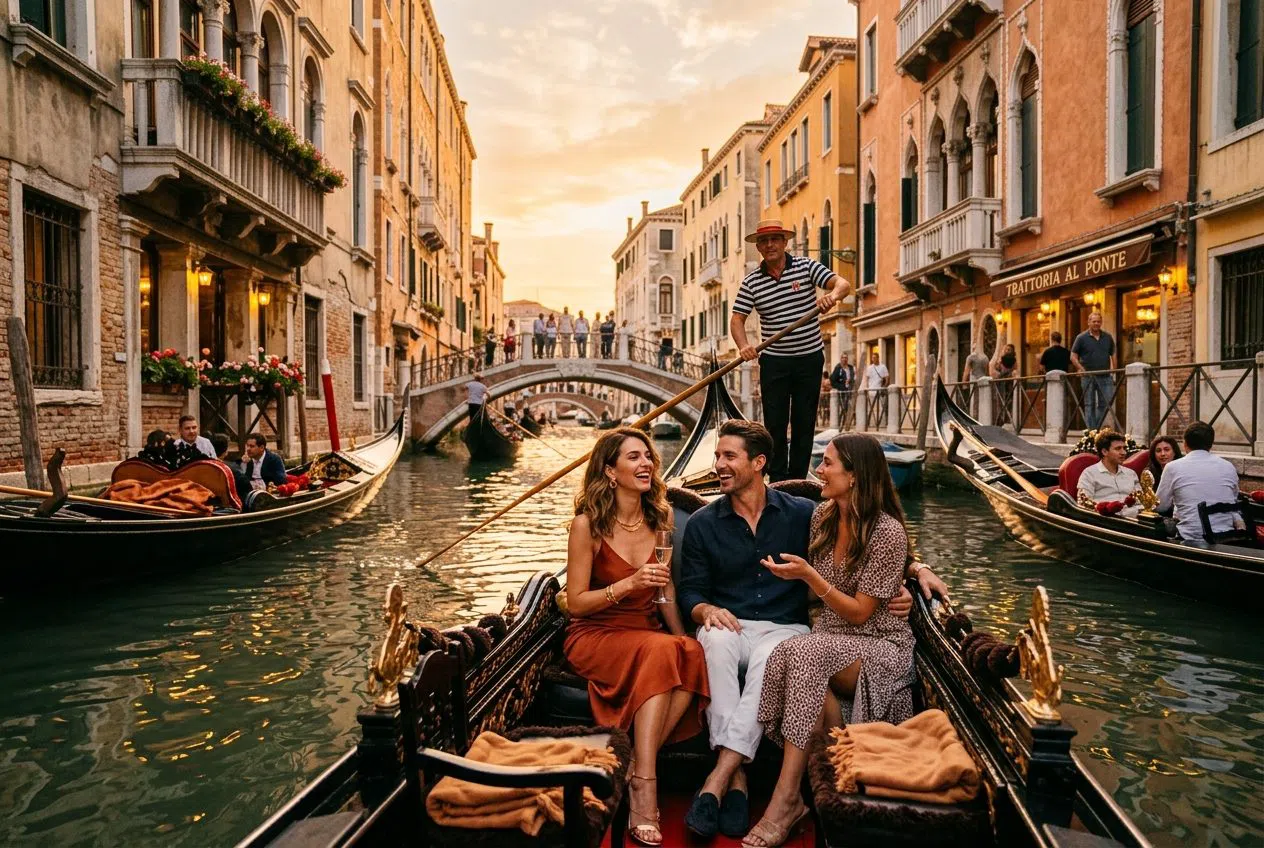
The gondola is the one Venetian cliché that survives contact with reality. You push off from a stazio, the noise of the city drops away inside thirty seconds, and you spend the next half hour looking at doorways and water gates built to be seen from exactly this height — about a metre above the canal, moving at walking pace. What ruins it, when it gets ruined, is almost never the boat: it's an hour queuing in August heat at the wrong station, or a tour desk charging a mark-up on a fare the city already fixes.
What a gondola costs in 2026 — and what it doesn't
The fare is regulated and it is charged per boat, not per person. As posted at the stazi in 2026 it is €90 for 30 minutes between 09:00 and 19:00, and €110 for 35 minutes between 19:00 and 04:00. Extensions run at €40 per extra 20 minutes. A gondola takes up to five passengers, so five people splitting a daytime ride are paying €18 each — which reframes the "gondolas are a rip-off" line you'll have heard from someone who went alone.
One wrinkle worth knowing before you argue with a gondolier: the official Venice tourist board page still quotes the older €80/€100 tariff and a six-passenger maximum. The rate actually posted at the stations is €90/€110 for up to five. The gondoliers are not overcharging you; the web page is behind.
Two more honest notes. Singing is not included — the serenade is a separate arrangement with a separate musician, and a gondolier who isn't singing isn't short-changing you, he's doing his actual job. And booking through a hotel concierge or a third-party site almost always adds a booking fee to a fixed public fare. Walk to a stazio, agree the time and the route before you step in, and pay at the end. Cash is smoothest; most stations now take cards but not all gondoliers will be pleased about it.
For everything else on planning a trip here — when to come, where to stay, what to skip — start with our Venice guide.
Plan your Venice trip
Live prices from our booking partners.
Free cancellation on many rooms. We may earn a commission when you book.
The Grand Canal stazi: for the big entrance
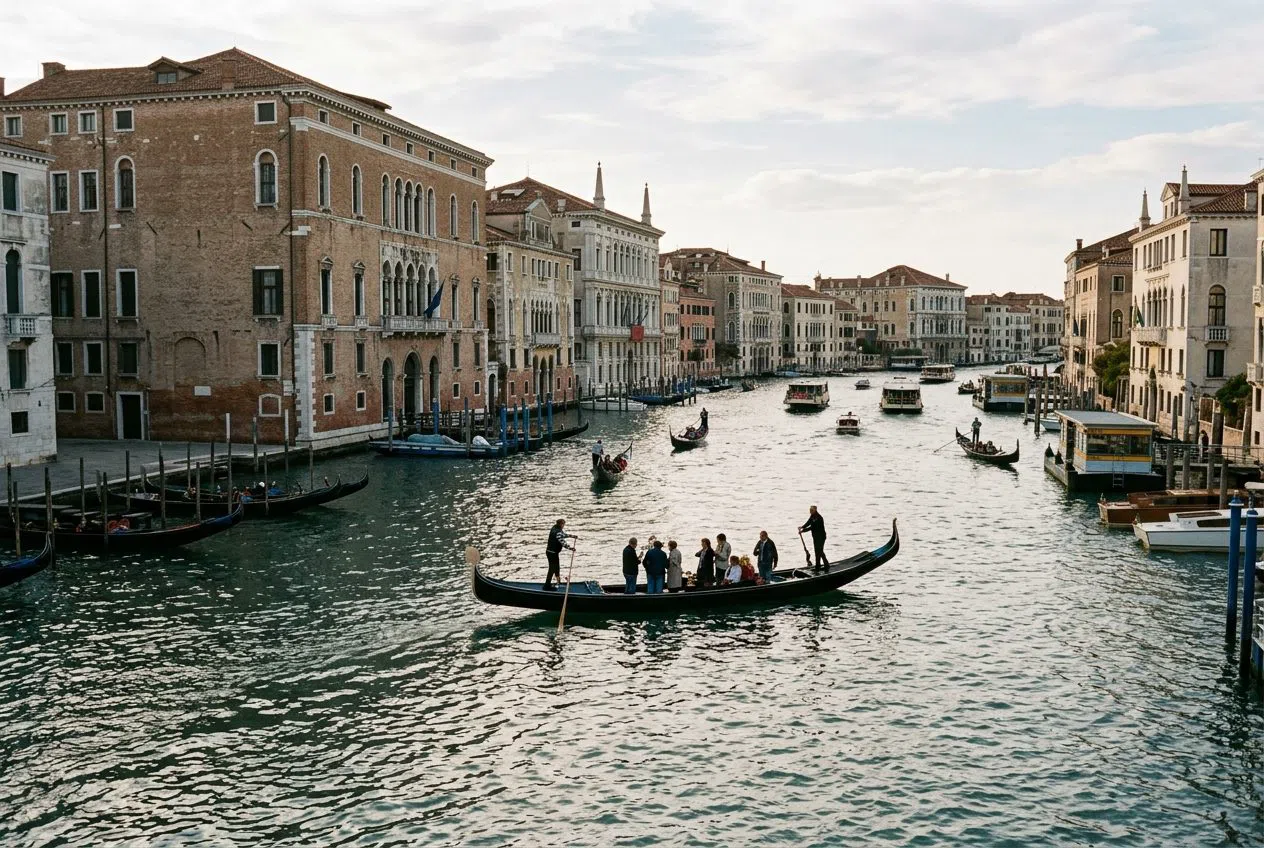
If you want the wide-water, opera-set version of Venice, you board on the Grand Canal and accept that you'll share it with vaporetti and delivery barges.
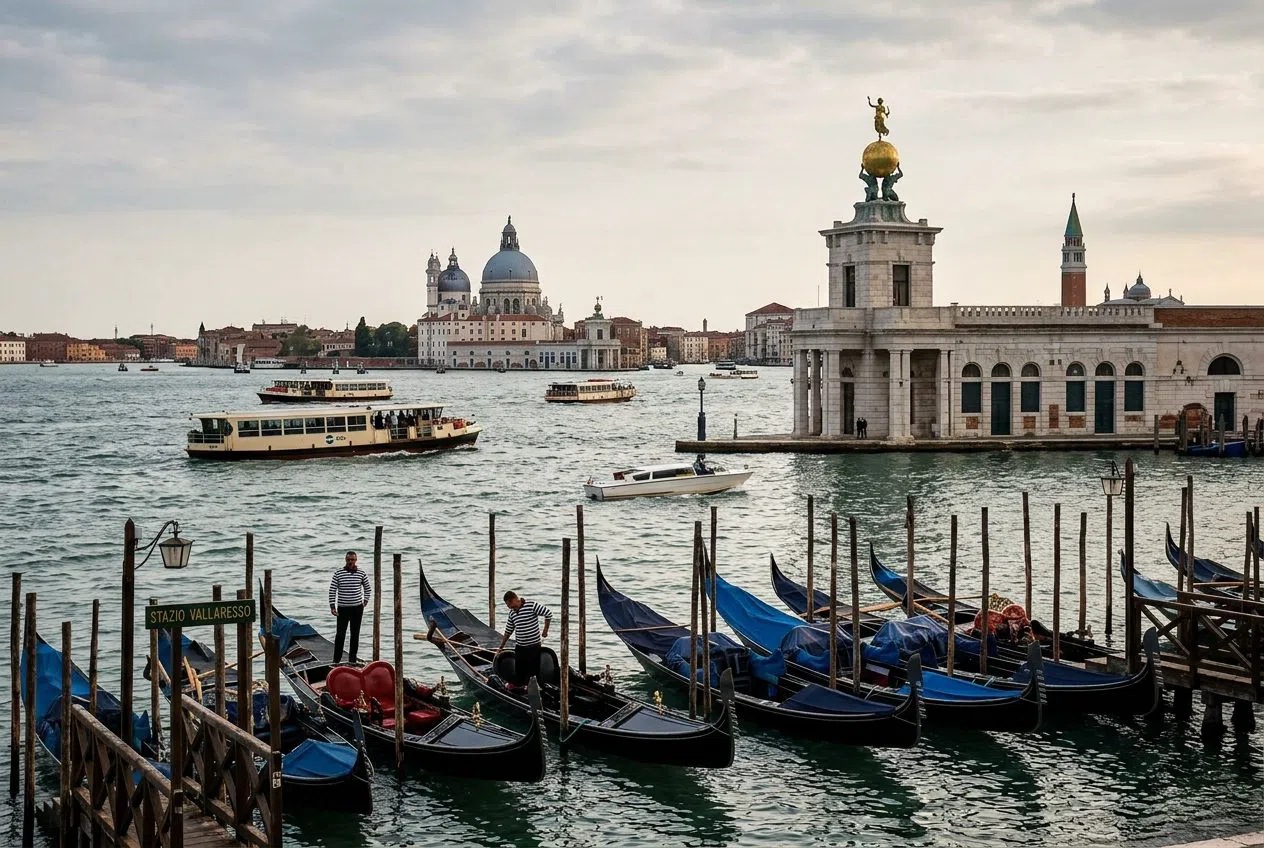
Stazio Vallaresso / Dogana (San Marco, at the water's edge by the Giardinetti) gives you the most cinematic departure in the city. You push off straight into the Grand Canal with the Salute filling the view, and because the launch point is wide open, several gondolas can leave abreast — which is genuinely the best photograph a group of twelve will get all weekend. The trade-off is chop. This is the most exposed water of any central station, and if anyone in your party is prone to seasickness, send them somewhere else and meet for a drink afterwards.
Two minutes' walk inland, Stazio Trinità (Calle Larga 22 Marzo, San Marco) does much the same job with a quarter of the scrum. It's smaller, easier to muster a group at, and it's the sensible fallback on the afternoons when both Dogana and Orseolo have gone. Nobody writes about it, which is precisely the point.
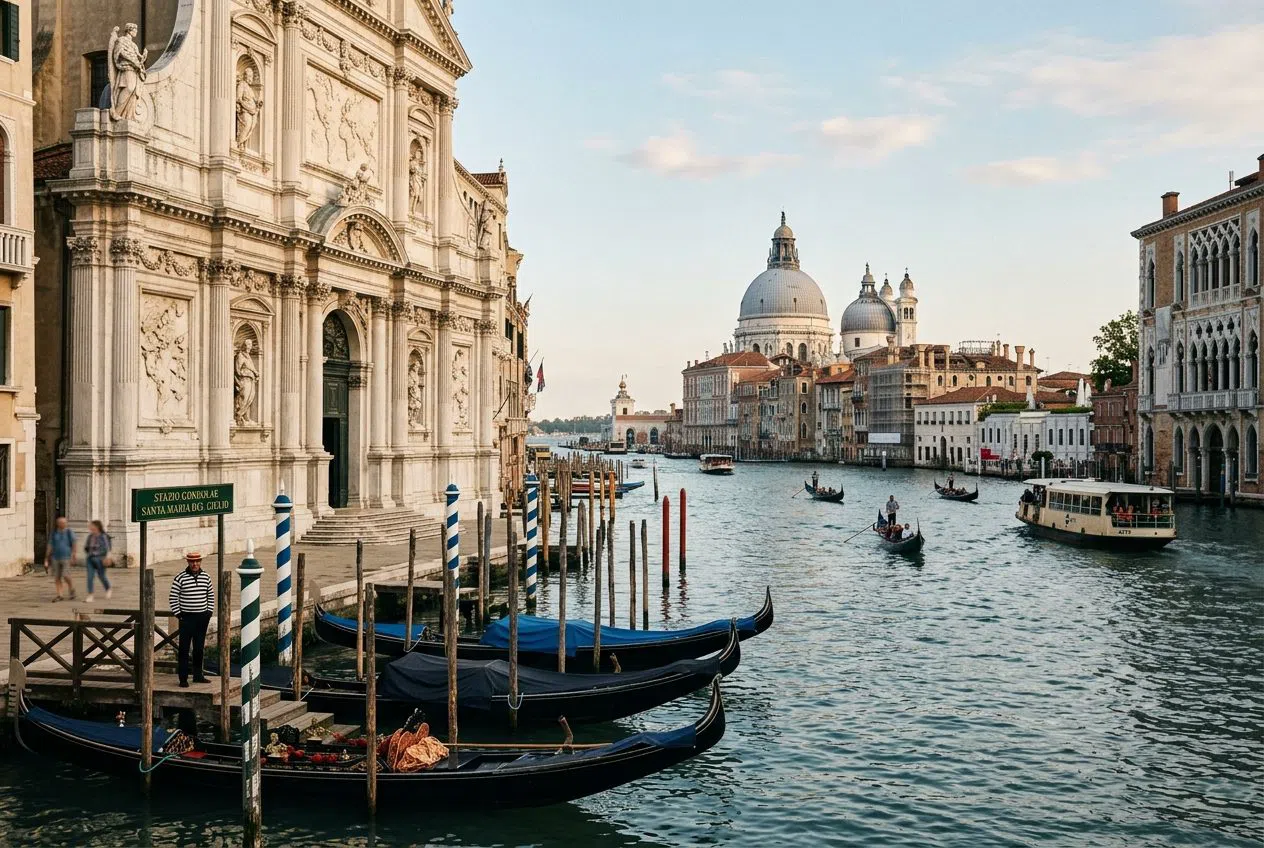
The best all-round compromise in Venice, though, is Stazio Santa Maria del Giglio (San Marco, on the Grand Canal below Campo Santa Maria del Giglio). It is two minutes from St Mark's, so you lose no walking time, but the route mixes a Grand Canal launch with genuinely quiet San Marco back canals — you get both halves of the experience in one 30-minute ride. It is noticeably calmer than Orseolo, and a party of eight to ten can usually be split across boats and away within twenty minutes off-peak. It's also the boarding point for most shared serenade flotillas, which matters if you're travelling in an odd number (see below).
The postcard routes, and what queuing for them costs you
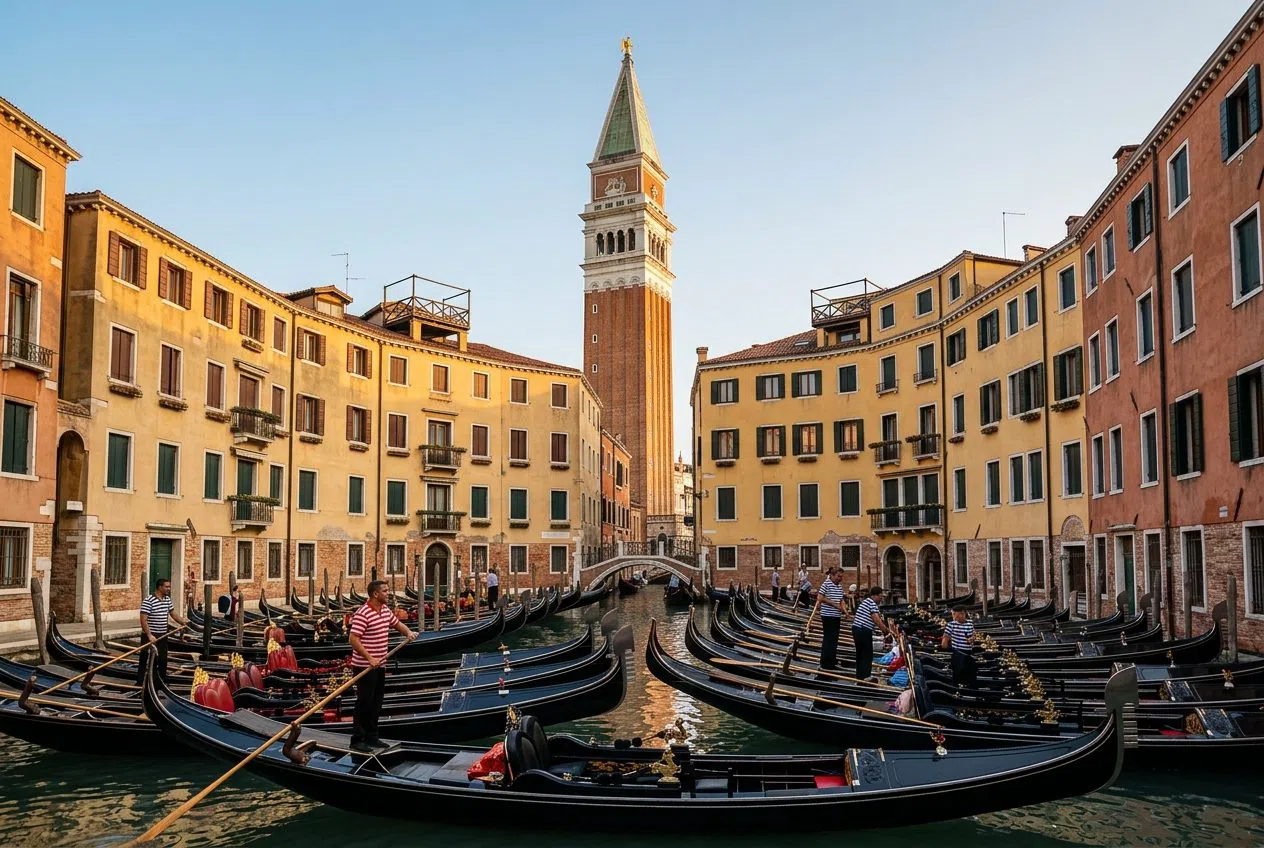
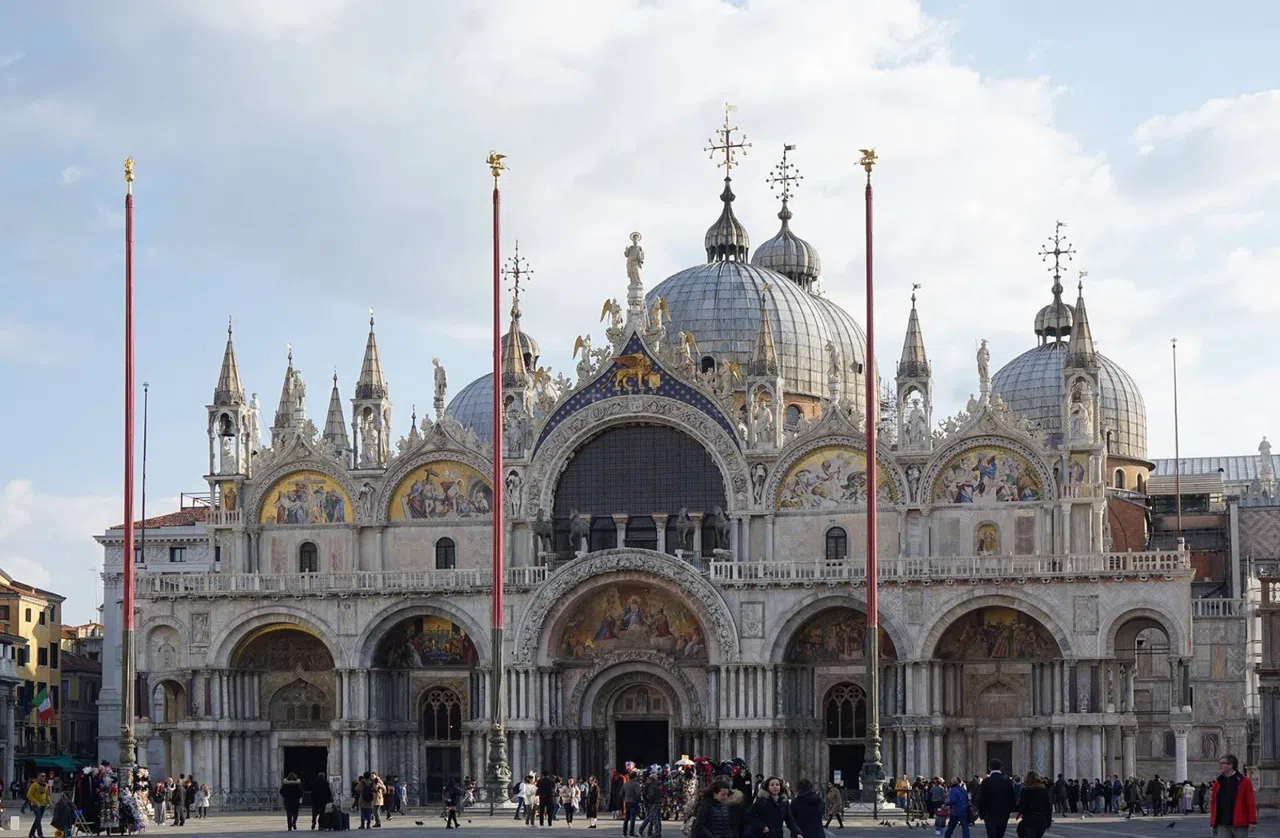
Stazio Bacino Orseolo (San Marco, tucked directly behind the Piazza) is the default for most first-timers and the busiest station in the city. In July and August the queue runs well over an hour. Treat it as an early-morning option — be there before 09:00 — rather than a mid-afternoon one, and it's transformed: the basin is full of moored gondolas, the light is low, and the water is glassy before the day's boat traffic churns it up.
Orseolo does have one unbeatable advantage: it has more hulls on the water than anywhere else, which makes it the only station that can launch a party of fifteen to twenty at once without a long wait. Larger groups are simply split across several boats that leave together. If you're organising a big group and everyone needs to be on the water at the same moment for the photo, this is your station.
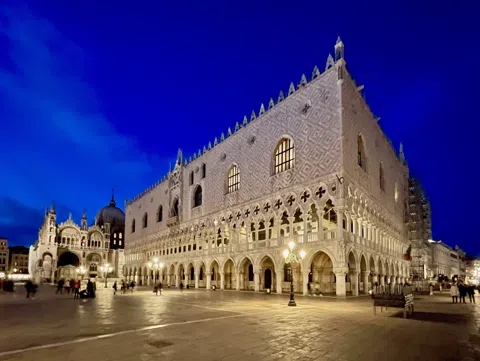
Stazio Danieli (Riva degli Schiavoni, Castello) is the Bridge of Sighs route and the single most in-demand stazio in Venice. It is also the most weather-dependent. The launch is straight onto lagoon chop, and gondoliers will refuse boarding in wind — departures get cancelled at short notice and groups get split without much warning. Build a fallback into your afternoon rather than treating it as booked. One point of confusion worth clearing up: the hotel the station is named after has been shut for restoration and reopens on 26 August 2026 as Danieli, A Four Seasons Hotel. The gondola station has operated throughout and is entirely unaffected.
Back canals: where the ride actually gets good
Here is the thing most guides won't say plainly. The Grand Canal is spectacular from a vaporetto and merely busy from a gondola. The rides people remember are the ones through canals barely wider than the boat, where the gondolier calls a warning at each blind corner and you go past somebody's kitchen window.
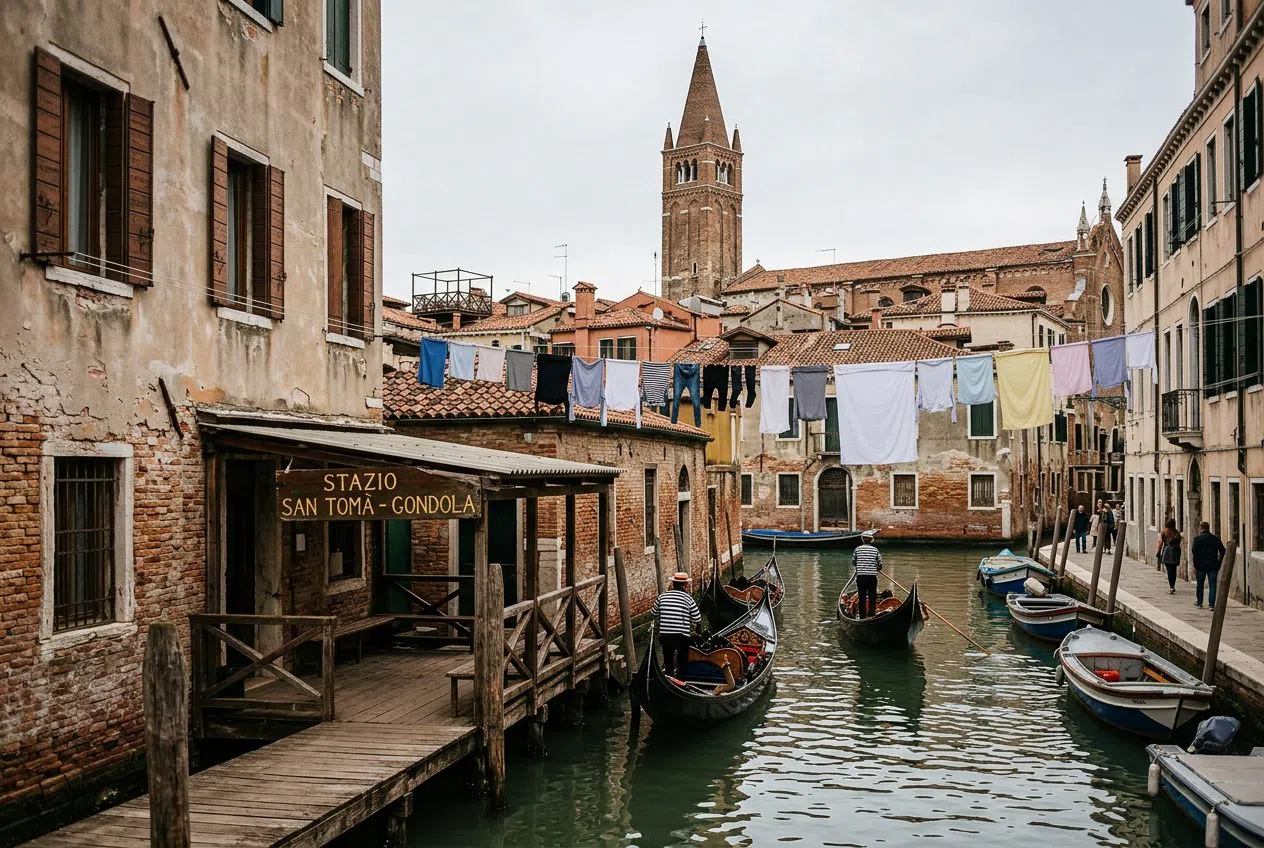
Stazio San Tomà (San Polo, beside the traghetto landing) is the pick for exactly that. The route works towards the Frari through genuinely residential water, and the station sits right next to the most reliable traghetto crossing in Venice, which makes it an efficient half-hour of your day. It has fewer gondolas on station than Orseolo, so a party over ten should ring ahead or expect a staggered departure.
Stazio Campo San Barnaba (Dorsoduro, at the Ponte dei Pugni) is the quiet-Dorsoduro alternative: barely any queue, canals with almost no other gondola traffic, and you finish within walking distance of Campo Santa Margherita for a drink afterwards. It's a small station that handles groups of up to about ten comfortably; beyond that you'll wait while boats cycle back. For couples who want the ride to feel private rather than processional, this is the one I'd send them to.
Stazio Campo San Felice (Cannaregio) is the locals' end of town and the value pick for anyone who has already done the Grand Canal. It has the quietest back-canal routing of any central station and a typical wait of about fifteen minutes even in season. It keeps few boats on station, so ring ahead for anything over two gondolas.
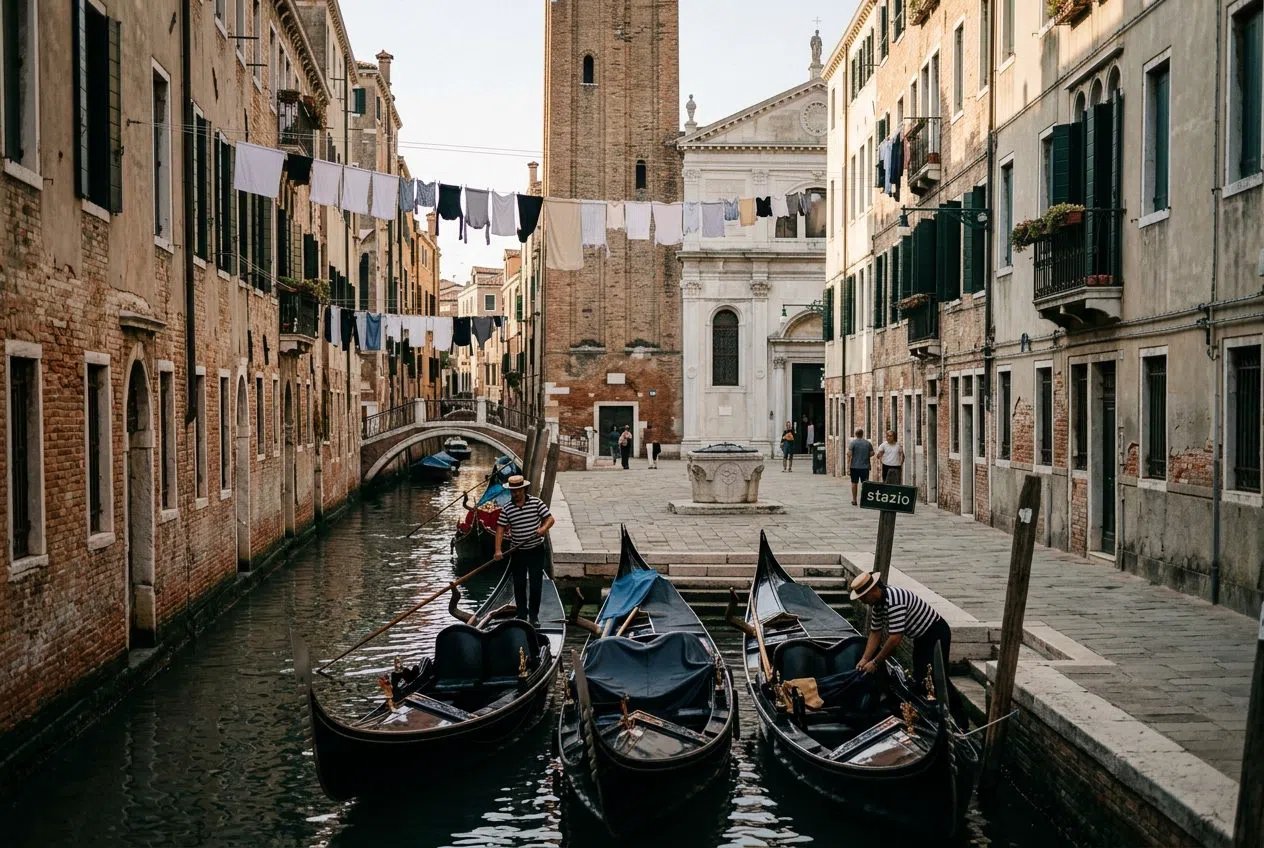
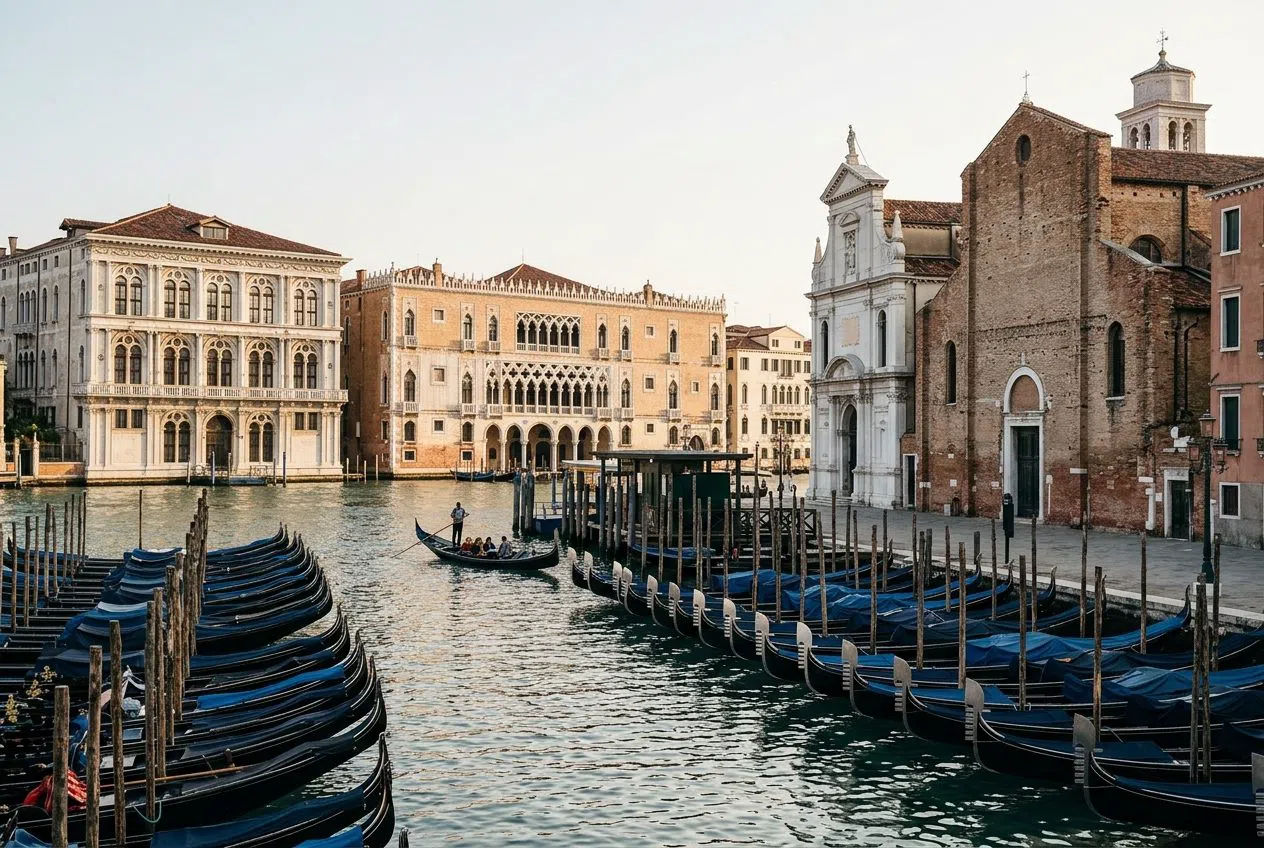
Stazio San Marcuola (Cannaregio) is the gateway to the Jewish Ghetto canals — a distinct Venice, more sombre, more residential, and a long way in feeling from the San Marco loop. It's one of the very few stazi where you can walk up and board on the spot in August, which in this city counts as a minor miracle.
And if you're doing Venice as a UK weekend, don't overlook Stazio Ferrovia (Ponte degli Scalzi, by Santa Lucia station). You can step off the train and be on the water in ten minutes, before you've even found your hotel, and the route heads into the Cannaregio and Ghetto canals rather than the tourist circuit. There are several boats on station and enough space on the fondamenta for a group to assemble without blocking the crossing. It is the most underrated station in Venice.
The €2 gondola: the traghetti
The traghetti are the surviving ferry gondolas that cross the Grand Canal where there is no bridge. They cost €2 per person, cash to the gondolier, and they are the one genuine bargain in the city. Be clear with your group about what this is: a two-minute crossing, not a tour. But it is a real gondola, rowed by real gondoliers, and for a family of five it costs €10 rather than €90.
Traghetto Santa Sofia (Cannaregio, Ca' d'Oro to the Pescheria) is the oldest and most reliable of the survivors, running roughly 07:30–19:00 in summer and 07:30–18:30 in winter. Locals do stand for the crossing; nobody will mind at all if you sit. There's no booking and no door policy — a group just queues and crosses in batches of about a dozen. Pair it with the Rialto fish market on the far bank and you have a genuinely good morning.
Traghetto San Tomà – Sant'Angelo (San Polo) is the most dependable after Santa Sofia — roughly 08:30–19:00 on weekdays and 09:00–18:30 at weekends — and it crosses at the canal's grandest sweep, so it's arguably the better view of the two. Walk-up only, groups cross in batches, no reservation possible. Worth knowing that the Riva del Carbon–Riva del Vin crossing, which older guidebooks still list, now runs weekday mornings only.
Row it yourself, and see where the boats are built
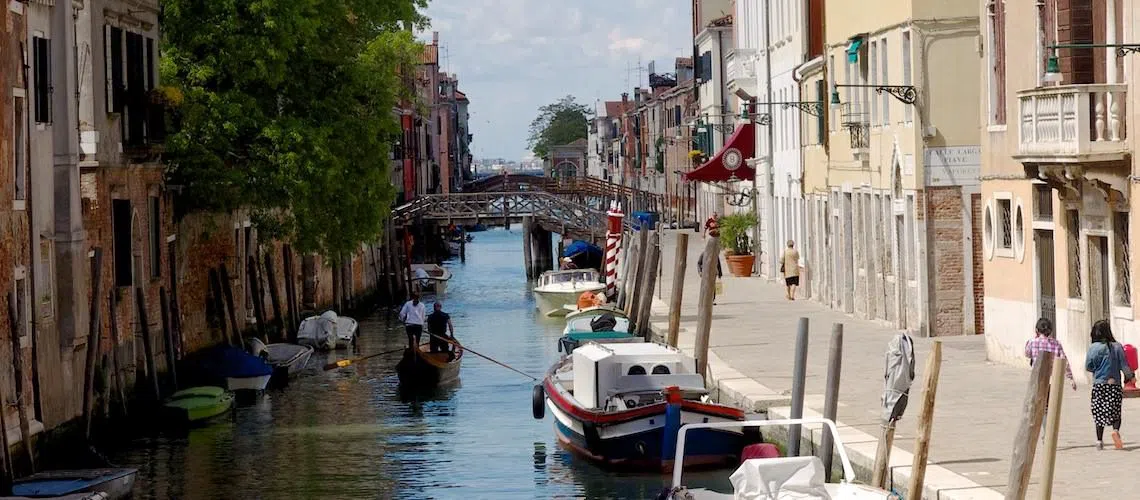
Row Venice (Cannaregio) is the one entry here that is an experience rather than a transaction. It's a non-profit run by Venetian vogatrici — women rowers — who actually teach you to row standing up, facing forward, in a batèla coda di gambero. An 80-minute classic lesson is €100 for two, €130 for three, €150 for four; boats take up to four, and larger groups go out as several boats together, which they'll coordinate for you. The Grand Canal Row runs €160–€280, and the Cicchetto Row — rowing between two bàcari with a stop at each — is €225–€375 per boat and is, without much competition, the best group booking on this list. Book well ahead; they're a small operation and summer weekends go early.
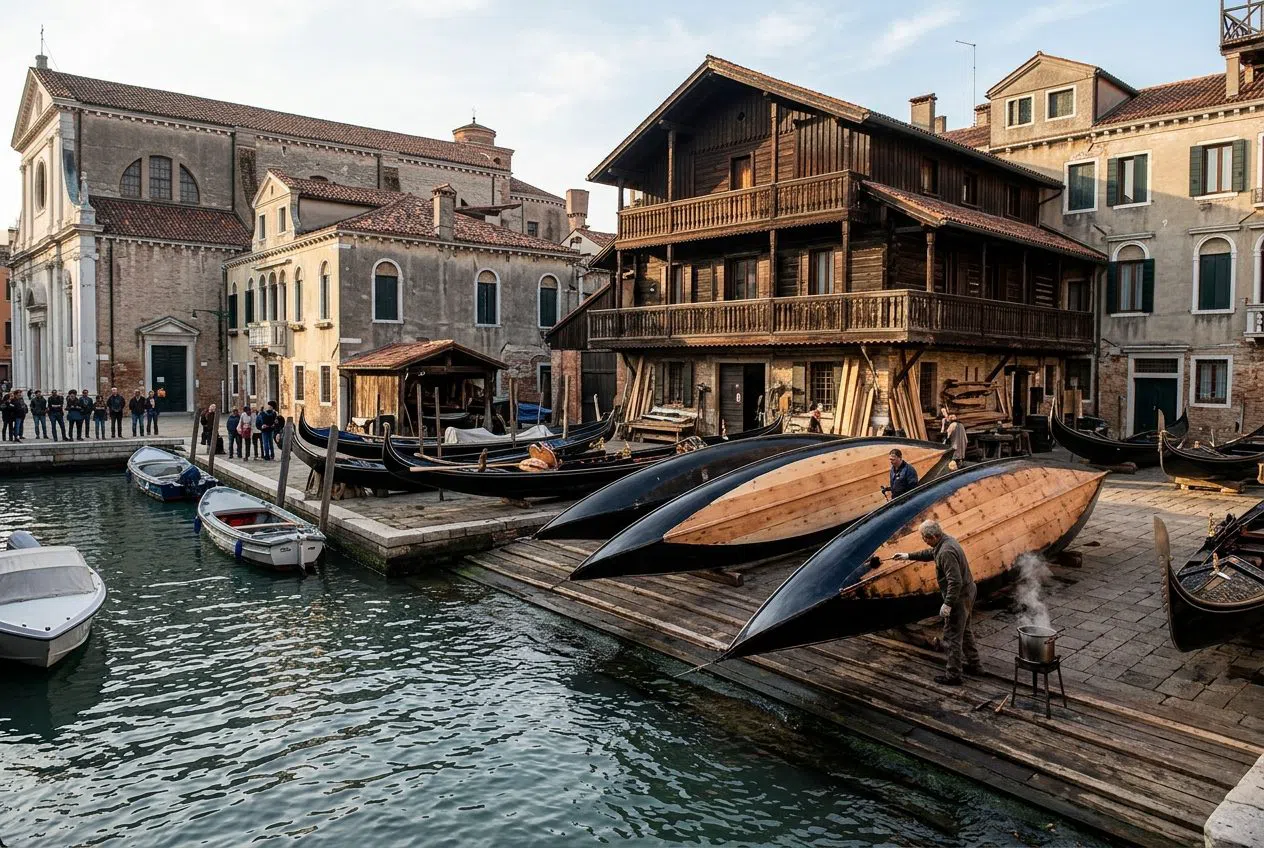
Squero di San Trovaso (Dorsoduro) is one of only three working squeri left building and repairing the gondolas of Venice. You watch from the fondamenta directly opposite, across the rio, and it costs nothing. Do not wander in: it is a working boatyard, not a museum, and it isn't open to walk-ins. Organised group visits have to go through a tour operator and typically run €40–70 per person. Ten minutes with a spritz from the bar opposite is the right dose, and it will change how you look at the boat you rode in.
Groups, odd numbers and stag weekends
If you're solo, three of you, or eleven of you, the private-boat maths stops working. Shared Gondola Ride with Serenade (boards near Santa Maria del Giglio, San Marco) sells by the seat at roughly €30–50 per person for 30 minutes, against €90 for a whole private boat. You're in a flotilla with strangers, which for a big group is irrelevant — you were sharing anyway — and the singing is delivered to the convoy rather than to you. It is unashamedly cheesy. It is also the correct answer for anyone travelling alone or in an odd number.
For larger parties, the short version: fifteen to twenty at once, go to Orseolo before 09:00. Eight to ten with minimal fuss, Santa Maria del Giglio. Over ten and you want back canals, ring San Tomà ahead. Want the whole group leaving abreast on camera, Vallaresso. Avoid pinning a group to Danieli, because wind cancels it. And if the group is a stag or hen party, be aware that gondoliers will refuse loud, drunk or standing passengers outright — the boats are unstable and the refusal is a safety call, not snobbery.
Practical notes
Getting there. Every station above is a short walk from a vaporetto stop of the same or similar name; the Line 1 down the Grand Canal passes most of them and is the cheapest sightseeing in Venice at any rate. From the airport, the Alilaguna waterbus is slow but scenic; the land bus to Piazzale Roma is faster and cheaper.
Cash. Bring some. The traghetti are cash-only, €2 a head, exact change appreciated. Cards work at most stazi but the traghetto gondolier will not be taking your phone.
Timing. Before 09:00 or after 19:00 are the two good windows. Early morning gives you flat water and empty canals; the after-19:00 tariff costs €20 more but buys five extra minutes and, in summer, the best light of the day. Mid-afternoon between June and September is the worst of everything — longest queues, hardest sun, busiest water.
Budget. A realistic plan for two people: €90 for a private 30-minute ride from San Barnaba or San Felice, €4 for a traghetto crossing at Santa Sofia, and €100 for a Row Venice lesson if you want one thing from the trip you'll still be talking about at Christmas. Under €200 for the pair, which is less than most people assume before they arrive.
Where to stay. San Marco puts you next to Orseolo, Giglio and Trinità but you'll pay for it; Cannaregio and Dorsoduro are quieter, cheaper and closer to the stazi worth using. Compare rates with our Venice hotel search.
Before you go
How much does a gondola ride cost in Venice in 2026?
The fare is regulated and charged per boat, not per person: €90 for 30 minutes between 09:00 and 19:00, and €110 for 35 minutes between 19:00 and 04:00, with extensions at €40 per extra 20 minutes. Note that the official Venice tourist board page still quotes an older €80/€100 tariff — the rate posted at the stations themselves is the €90/€110 one.
How many people fit in one gondola?
Five passengers at the regulated fare. Larger parties are simply split across several boats that leave together — Stazio Bacino Orseolo has enough gondolas on station to launch a group of 15–20 at once, while smaller stazi like Campo San Barnaba or Campo San Felice comfortably handle around ten before you start waiting for boats to cycle back.
Is there a cheap way to ride a gondola in Venice?
Two. The traghetti — the ferry gondolas that cross the Grand Canal — cost €2 per person in cash; Traghetto Santa Sofia at Ca' d'Oro is the most reliable, running roughly 07:30–19:00 in summer. Or book a seat on the Shared Gondola Ride with Serenade near Santa Maria del Giglio at roughly €30–50 per head, which beats a private boat if you're solo or an odd number.
Which gondola station has the shortest queue?
Stazio Campo San Felice in Cannaregio typically runs about a 15-minute wait even in season, and Stazio San Marcuola is one of the very few where you can walk up and board on the spot in August. Avoid Bacino Orseolo in the afternoon between June and September, where queues run over an hour.
Do gondoliers sing, and can you book a gondola in advance?
Singing is not part of the standard fare — a serenade is a separate arrangement with a musician, and the shared flotilla tours deliver it to the whole convoy rather than to your boat. You generally don't need to book: walk to a stazio, agree the route and time before boarding, and pay at the end. Booking through a hotel or third-party site usually just adds a fee to a fixed public fare. The exceptions are Row Venice, which sells out weeks ahead, and any party of more than ten at San Tomà, which should ring the station first.